Grandpa's flute
I play some flute.
My Grandpa wanted to play the flute.
For this he had bought one.
Unfortunately he didn’t manage to learn it.
I wanted to learn Clarinet.
When I first entered Year 7 my parents explained that we couldn’t afford an instrument for instrumental music.
Hence my Grandfather offered his flute.
For four years I did group flute classes.
I didn’t want to learn tunes from a book called “Flute Fancies.”
I was limping along musically.
The rigour of the classical music we were often playing was too much for me.
There were things my flute teacher didn’t know about me.
My Grandfather on the other side had given me a love of classical music.
And that I secretly wanted to be a composer.
I didn’t even know where to begin to make that real.
Which is a strange ambition for a kid who is not really enjoying his instrumental classes.
At the end of Year 10 my formal flute learning journey petered out, with me quitting.
I didn’t really touch the flute for a few years even though I still had it.
What happened next has passed into personal legend.
I was 19.
One day I put on Nirvana’s Nevermind album. And on a whim grabbed my flute.
Before this happened I didn’t really know what jamming was or how one might do it.
Back in my school days my group classes had given perfunctory if any attention to jazz.
But I now stumbled on the way forward. I listened to the music. I played a note at random. And listened. I then picked another note and played that. If a note didn’t seem to fit I noticed that and discarded that from my pool of available notes.
My ear and fingers ran this simple algorithm imperfectly.
It would be beautiful if a flute practice sprang fully formed from these humble beginnings but things were way more sporadic.
I sometimes put radio on and jammed to whatever was playing.
There were some beautiful experiences.
I used to walk around barefoot improvising at my friends house while she was cooking dinner at our weekly bible study meet-ups.
I went to some jam nights.
The Music Director at a small church I was attending invited me up to play without ever having heard me knowing that I was an improviser that didn’t really read music. She must have liked what she heard, too, because I was siting up the back while the prayer team were quietly praying for people up the front, and she walked past and said “Grab your flute”. She played soft acoustic guitar while I improvised. I returned to my seat and a friend remarked “That was beautiful.” Once I dropped in on a friend whose son and son’s friend were playing Nirvana on their acoustics. I told them my flute was in the car and I’d come in for a jam if they were still playing after a good chat with my friend first. They were, so I did. The son’s friend said afterwards “I thought flutes were what girls played softy in the school band and our guitar’s where going to overwhelm your flute.” I told him “I don’t play it like that.”
Since school I’ve taken the odd formal lesson here and there. But nothing quite worked.
Now I’m trying a new strategy. Revisiting my old strategy.
I have started jamming to Nirvana’s Nevermind album again.
On the musical journey, years ago, I also ran into the book and set of learning materials released by Improvise for Real.
Alas such an approach was overwhelming and still too structured for me.
Even though the actual materials as far as I was able to get into them made a lot of sense.
In the interim I have been working on myself. My learning experiments across different subjects have been paying dividends. And building my confidence in my own agency.
A fact about my flute playing is that beyond the basics. Bb , C, G and F major my knowledge of keys is not strong.
This doesn’t mean practically that I can’t jam in other keys. But it makes it harder.
In my learning investigations I discovered a pattern that works for me.
And it turns out that my approach to learning to jam, learning to jam to Nirvana perfectly fits that pattern.
I call this pattern a sandbox.
The pattern is to have a simple rule, or set of rules, and a looping architecture.
My technique of listening to the music/musicians I’m playing along with, hanging a note out there and listening to see if I fits, makes for an elegant sandbox. I am now at the point in my musical development where I have decided the next thing to do is to use my barebones improvisational method to learn the major keys. One of the products I have purchased from Improvise for Real, but barely used is their backing tracks in all the different major keys.
The germ of the idea was: What if I had a system which could play one of these tracks at random such that I could practice improvising without seeing the track name and hence what key it is in.
So as a non-programmer I used AI and built it.
I called it Kurt.
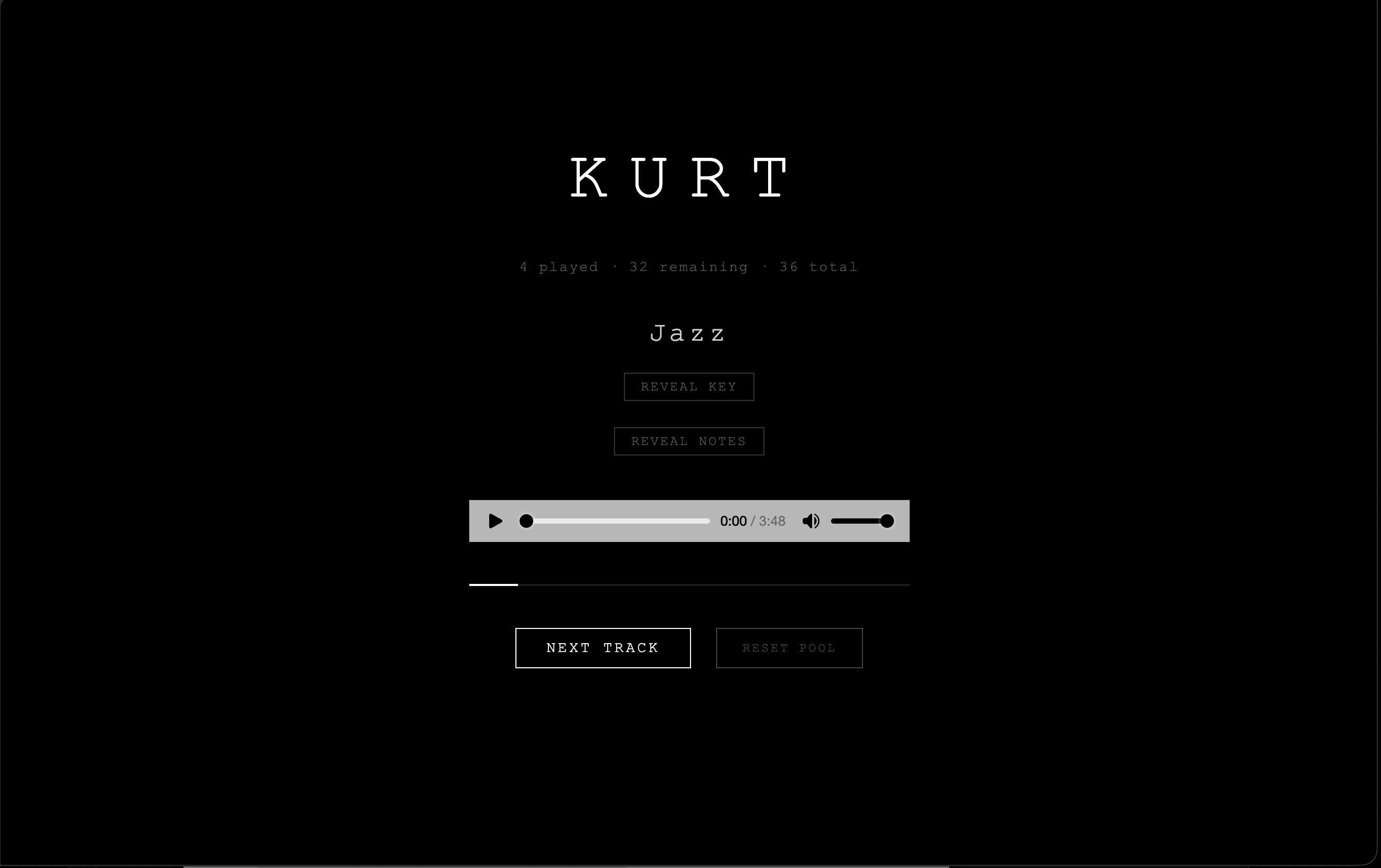
There is a helpful wrinkle to the randomisation too: Once you’ve jammed to a track, it removes that track from the pool of tracks it randomly selects from.
You can shut down the software too, and it remembers the tracks you’ve already played.
It also has special buttons that allow you to reveal the track key, and another that reveals the notes in that key.
Improvise for real also helpfully has 3 backing tracks for each major key in different moods: Meditative, Modern and Jazz.
I have also discovered another helpful technique to augment the learning. After I have jammed in a key that I didn’t know the name of, that I didn’t figure out fully, I chat with a LLM after giving it the notes I discovered and the key I revealed. It always turns out that I wasn’t doing something random.
Being given a narrative about what you were doing/discovering is encouraging.
I have also begun extending my exploration to other album’s beyond Nevermind.
I have been working out some of the colours and motifs in Hania Rani’s Esja and Rose Riebl’s Do not move Stones. These albums are well known enough that I can discuss the notes that seem to fit and something of the note patterns, again with an LLM, and get meaningful information out of doing that. This is my up to the moment approach to learning music and it already feels way more sticky than former sporadic attempts.
I am content. And reliably moving forward.